For decades, lighting design has focused on improving artificial light through greater efficiency, smarter controls and higher visual comfort. These advances have transformed the way we illuminate buildings, making lighting systems more sustainable and technically sophisticated than ever before.
Yet one question remains. Why do some spaces simply feel better than others?
The answer often lies beyond illumination itself. It lies in daylight.
Artificial daylight is a lighting approach that recreates the visual qualities of natural daylight, the perceived depth of the sky, the directionality of sunlight, atmospheric perspective, in spaces where real daylight cannot reach. Unlike conventional lighting, it is not designed simply to illuminate a room, but to make that room feel connected to the sky.
Natural daylight shapes the way we perceive architecture. It influences our sense of space, helps us understand depth and orientation, and creates an emotional connection with the built environment. Long before artificial lighting existed, the human visual system evolved under the open sky, learning to interpret the direction of sunlight, the colour of the atmosphere and the subtle changes of daylight throughout the day.
Perhaps the next evolution in lighting design is not about producing better artificial light, but about recreating the experience of daylight indoors.
Have we improved the experience of artificial daylight?
When we enter a room, we instinctively recognise whether it feels open or enclosed, calm or stimulating, natural or artificial. Much of this perception depends on visual cues that daylight has provided throughout human evolution: the direction of the sun, the apparent depth of the sky and the way light interacts with surfaces. These are qualities that conventional lighting rarely reproduces.
This raises an important question for architects and lighting designers: can we design not only with light, but with the visual qualities of daylight itself?
Artificial daylight is not simply brighter illumination. It recreates the visual qualities of natural daylight in spaces where access to real daylight is impossible. In a recent webinar for the Society of Light and Lighting (SLL), Professor Paolo Di Trapani, founder and CEO of CoeLux, explored this new perspective. Rather than treating lighting as a purely technical discipline, he proposes an interdisciplinary approach where physics, perception, architecture and the visual arts work together to recreate the experience of the sky indoors.
Watch the webinar recording
Artificial daylight as an architectural material
Throughout history, daylight has never been considered simply a source of illumination.
The Pantheon's oculus remains one of architecture's greatest examples of how the sky itself can become part of a building. More recently, artist James Turrell has dedicated his work to exploring the relationship between light, perception and the sky. His latest Skyspace, As Seen Below – The Dome, at the ARoS Art Museum in Denmark, continues this research by transforming the changing sky into an architectural experience.
As cities become denser and access to natural light becomes more limited, recreating these qualities inside buildings is becoming one of architecture's greatest challenges. This is where CoeLux fits into the conversation. Developed through years of scientific research in optics and visual perception, CoeLux recreates the visual experience of natural daylight and the apparent depth of the blue sky, allowing architects to integrate the perception of daylight into spaces where conventional skylights are impossible, from underground transit hubs to windowless clinical rooms.
When did ceilings stop being part of architecture?
Scroll through social media and you'll find countless comparisons. Colourful cars have gradually been replaced by endless shades of grey. Handcrafted iron door handles have become anonymous hardware. Rich architectural details have often given way to perfectly smooth surfaces. In many cases, performance has taken priority over experience, and ceilings tell a similar story.
Historically, ceilings played an active role in shaping architecture (check out this Instagram page, the Italian style!). They directed attention and helped define the identity of a space. Today, they are often treated as purely technical zones, designed to conceal mechanical systems, recessed luminaires and services.
Perhaps it is time to look up again. Instead of seeing the ceiling simply as infrastructure, what if we considered it once more as an architectural surface capable of reconnecting people with the experience of daylight? This is precisely the space CoeLux systems are designed to occupy.
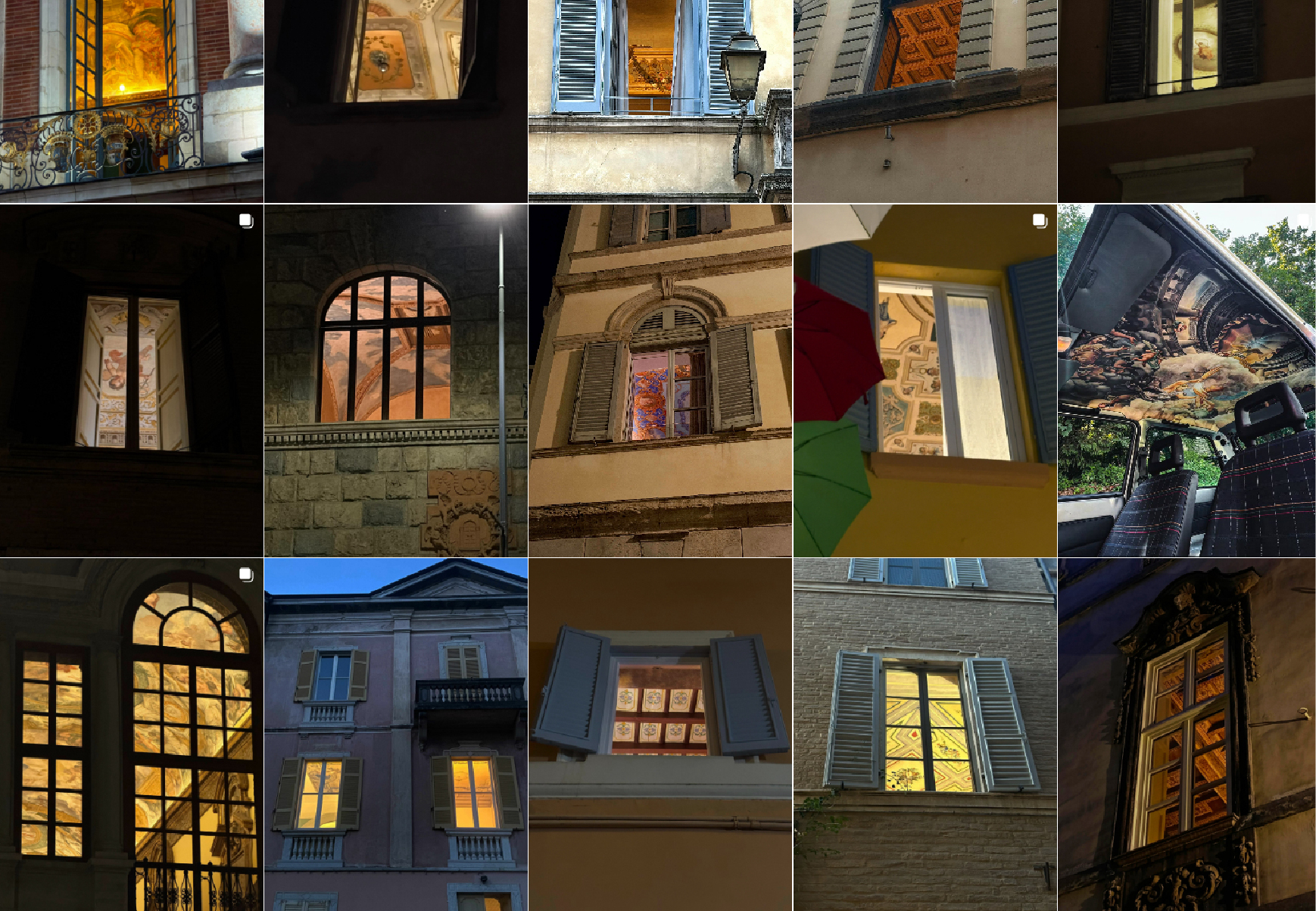
Soffittidellefinestre Instagram profile
Beyond lighting: designing with the experience of the sky
People spend the vast majority of their lives indoors, a shift that has made access to natural daylight increasingly limited across modern building types. Artificial daylight is not about replacing the sun. It is about recreating the perceptual conditions that make interior spaces feel open, comfortable and emotionally engaging.
By combining advances in optics, human visual perception and architectural design, CoeLux enables architects to introduce the visual presence of the sky into workplaces, healthcare environments, hospitality projects and residential interiors where access to natural daylight is impossible. Rather than asking how efficiently we can illuminate a room, we begin asking how architecture can recreate one of humanity's oldest spatial references: the sky itself.
A new design perspective
As research continues to demonstrate the importance of daylight for wellbeing, perception and spatial quality, architects are increasingly rethinking the role of light within buildings. Artificial daylight is emerging as more than a lighting solution. It is becoming an architectural tool capable of transforming underground spaces, healthcare environments, workplaces, hospitality projects and residential interiors into places that feel naturally connected with the outside world.
CoeLux builds on this vision by translating decades of scientific research into architectural solutions that recreate the visual experience of daylight wherever natural light cannot reach. Perhaps the future of lighting is not simply brighter, smarter or more efficient. Perhaps it is about bringing back the experience of the sky.
-min.jpg)
Natural working space - CoeLux at Nordea Bank in Warsaw
Frequently asked questions
What is artificial daylight? Artificial daylight is a lighting technology that reproduces the visual qualities of natural daylight, sky depth, sunlight direction and atmospheric perspective, in interior spaces where real daylight is not accessible. In practice, it works like a window that reproduces sky and sun rather than a fixture that simply illuminates a room.
How can you reproduce daylight without reproducing the sky and the sun? You can't, and this is the core of the approach. Daylight is not just brightness: it is the combined effect of a directional sun and a diffused, deep-looking sky. Reproducing daylight convincingly means reproducing both elements together, optically, the same way the atmosphere does: scattering light to generate a sense of sky depth, while keeping a sharp, directional source to recreate the sun. Without both, the result reads as a bright ceiling, not as daylight.
How is artificial daylight different from standard artificial lighting? Standard lighting is designed to illuminate a space efficiently. Artificial daylight is designed to recreate the perceptual experience of the sky and the sun, aiming for the emotional and spatial effect of natural light rather than illumination alone.
Where is artificial daylight used? Typical applications include underground or windowless spaces, healthcare facilities, workplaces, hospitality venues and residential interiors where conventional skylights or windows are not possible or sufficent.
Who developed first the artificial daylight technology? CoeLux was founded by Professor Paolo Di Trapani, building on years of scientific research in optics and human visual perception. Entirely developed in Italy, CoeLux combines scientific innovation with Italian design and manufacturing excellence.
Ready to design with the sky?
If you're an architect, interior designer or lighting designer and would like to learn how to integrate CoeLux into your projects, send us a message.
We'd be happy to guide you through design principles, applications and technical solutions.
Let's bring the sky indoors.
General information: info@coelux.com
For residential projects and commercial enquiries: sales@coelux.com